


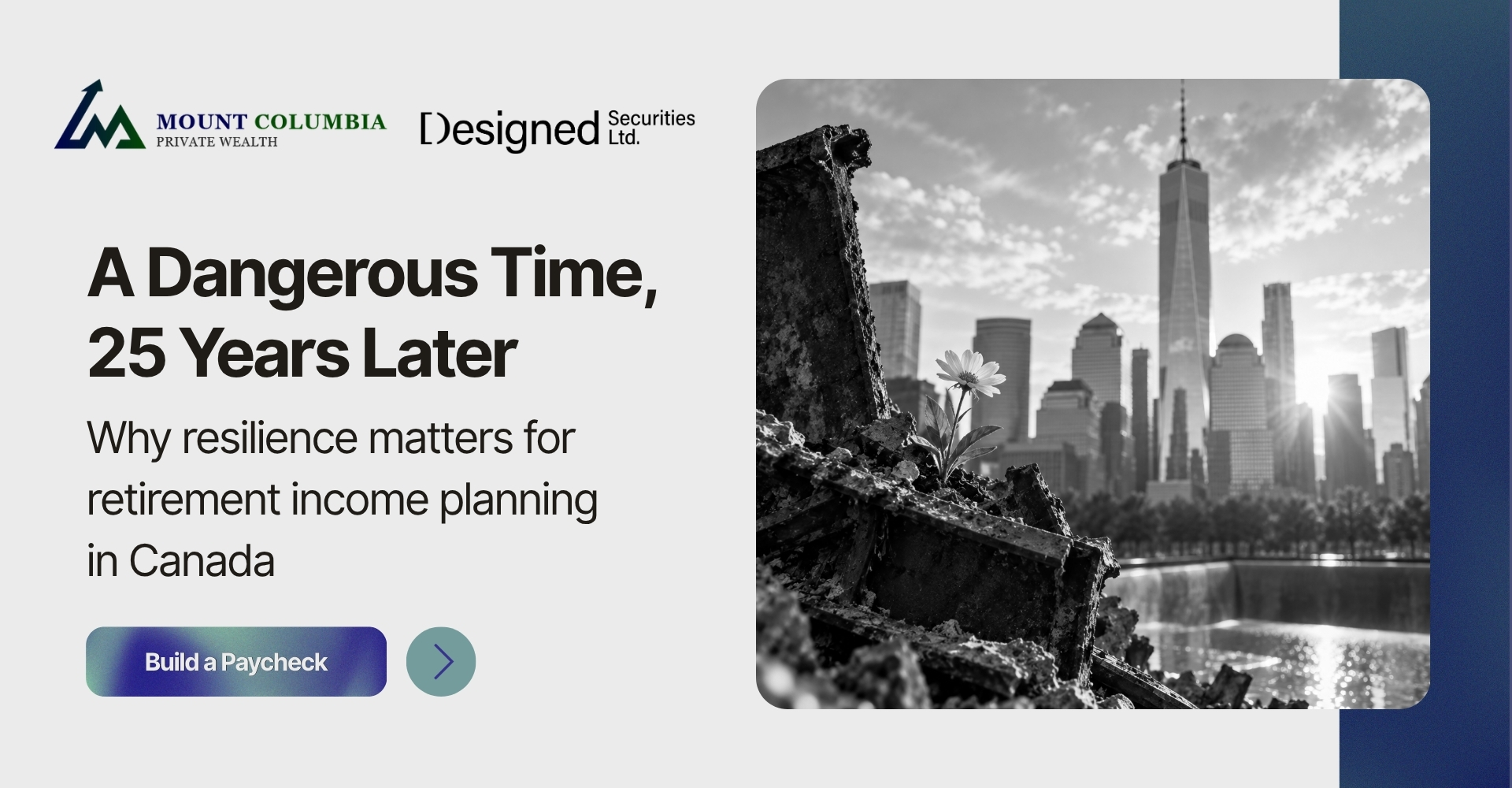
Twenty-five years ago, I was on an MBA tour of American business schools with my father. On September 10, 2001, we crossed the border from Ontario into Detroit and stopped in Ann Arbor, where I had a class visit and an interview scheduled at the University of Michigan. It was an experience that would eventually shape how I think about resilience, risk and retirement income planning Canada strategies today.
Midway through the class the next morning, the world changed. As word of the attacks spread, the campus came to a halt. Students and staff gathered around televisions to watch and to mourn. I had a short meeting with my interviewer and concluded my visit there.
My father and I debated what to do next. We decided to keep going to Chicago, where I had meetings at Northwestern and the University of Chicago scheduled over the next two days. The four-hour drive felt like thirty minutes; we spent all of it listening to the radio. The following week I was due at Columbia Business School, and after some research and a call with the admissions department, we drove to Manhattan.
I will never forget the smoke rising from the site, visible all the way from midtown. Posters of missing friends, family members and colleagues were plastered on every surface. Young children had written letters to their missing parents and pinned them to bulletin boards. And alongside the shock and grief and fear there was something else: a community determined to come together and show its resilience. It did exactly that, in a dangerous time.
I keep returning to that phrase, because we are in a dangerous time again — a very different one, which asks something different of us. For retirees, it also raises an important question about retirement income planning: how do you build a portfolio resilient enough to keep producing income when the economic environment changes?
What has changed since 2001
There is a clever argument making the rounds: that a Federal Reserve rate hike would actually be good for stocks, because it would prove the new chair means what he says about getting inflation back to 2%. Markets prize credibility. Remove the uncertainty, the thinking goes, and investors can refocus on the AI buildout.
But look at how much room the system has lost since 2001. In the days after the attacks, the US Federal Reserve cut interest rates and kept cutting through the year. It could afford to. Inflation was not a problem, Washington was running a budget surplus, and net interest on the US national debt was comfortably smaller than the defense budget.
None of that holds today. The US federal deficit passed $2 trillion with a month still left in the fiscal year. Net interest on the debt now runs roughly $1.25 trillion annually, about 18.5% of all federal revenue, past the previous high set in 1991, and more than the entire defense budget. Total debt sits near $40 trillion, and debt held by the public exceeds the size of the economy.
And the Fed is not cutting. It is considering a hike. U.S. headline inflation is running near 3.4%, oil has been climbing, and the 30-year Treasury yield settled above 5.3% this week — the highest long-term yields since 2004. The Bank of Canada held at 2.25% on September 2 for the seventh consecutive time, but flagged rising upside risks to its inflation forecast, citing energy prices and the new round of tariffs. Canadian CPI has drifted back toward 3%.
There are potential parallels to the stagflation of the 1970s, though employment has so far held up in both countries. Inflation that will not sit down, energy pushing upward, long-term interest rates at twenty-year highs, and governments with far less capacity to absorb the next shock. Resilience, in 2026, is something portfolios must supply for themselves.
Why this matters most to retirees: sequence-of-returns risk
Sequence-of-returns risk says that once you are withdrawing, the order in which returns arrive matters enormously.
If a $2 million portfolio falls 20% in the first year of retirement and you withdraw $100,000 to live on, you are down closer to 26%, and the investments you sold are gone. The bounce eventually arrives; the shares sold to pay for groceries do not come back with it. And the traditional shock absorber, a 40% bond allocation, is precisely what fails when the shock is an inflation shock rather than a growth shock.
For anyone thinking about retirement income investing, managing this risk becomes particularly important once regular portfolio withdrawals begin.
Retirement Income Planning in Canada: Build a Paycheck, Not a Pile
The framing we use with retirees is deliberately unglamorous. You are not trying to beat an index. You are trying to replace a paycheck. To do that, you need more tools than a conventional balanced portfolio (and the typical traditional financial advisor) provides.
Examples of these tools include: infrastructure assets with contracted, often inflation-linked revenue, senior secured private credit at floating rates, and professionally managed option mandates designed to generate income yield in the low double digits.
The goal of retirement income planning is not simply to accumulate the largest possible pile of assets. It is to design those assets around the income they need to reliably produce.
Why I do this work: pension-style investing
That trip in September 2001 ended at Columbia, and Columbia is where I went on to study. After graduating I worked at large financial institutions and a pension fund. That is where I first met the philosophy that has shaped my work since: begin with the liability (what must be paid, to whom, and when), then build the asset mix to meet it.
Canada’s large pension plans invest this way, holding private credit, infrastructure and real assets because those cash flows are more predictable than public equity prices, and because a pension plan is structurally never a forced seller. My work now is making that approach available to families.
This week, the US Federal Reserve will make a decision on interest rates. Whether a quarter point proves bullish, bearish or a non-event, the retiree’s problem is unchanged: the portfolio must produce a reliable paycheck through an environment nobody can forecast, with less policy cushion behind it than at any point in my working life. That is a design question, not a prediction question. This is why proper advice has never mattered more than it does now.
And for retirement income planning in Canada, this is why proper advice has never mattered more than it does now.